
Websites are among the most commonly cited sources in student work — and among the most commonly cited incorrectly. The format changes depending on which style guide your assignment requires, and each style handles missing information (no author, no date, no page title) differently.
This guide covers the four most widely used academic citation styles: APA 7th edition, MLA 9th edition, Chicago 17th edition (Notes-Bibliography), and Harvard (Cite Them Right). For each style, you will find the standard format, a worked example, and clear guidance on how to handle the most common edge cases.
Before you begin: check your assignment brief carefully. Your institution or instructor may specify a particular style or a particular variant of Harvard. When in doubt, ask before you submit.
Quick Reference — Website Citation Formats at a Glance
Before the full breakdowns, here is a summary of how each style formats a standard website citation. Use this as a quick reminder once you understand the rules.
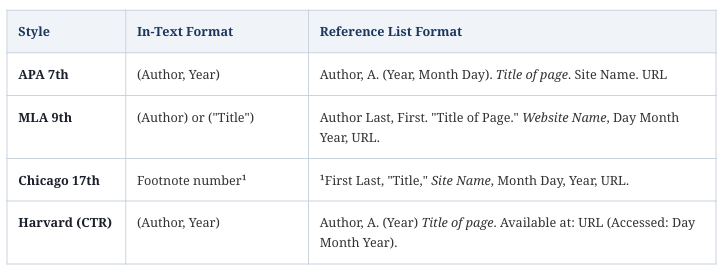
Table 1: 2026 Comparison of Website Citation Formats (APA, MLA, Chicago, and Harvard)
A Note on Harvard Referencing Before We Begin
Unlike APA, MLA, and Chicago — which each have a single authoritative governing body and published manual — Harvard referencing has no single official standard. It originated at Harvard University but has never been published as a unified style guide. Different universities use slightly different versions.
This guide uses the Cite Them Right (CTR) Harvard standard, specifically reflecting the 13th edition (2025), which is the most widely adopted version across UK universities and internationally. If your institution provides its own Harvard referencing guide, that takes precedence over what is shown here — always check your student handbook.
APA 7th Edition — How to Cite a Website
Governing body: American Psychological Association. Current edition: 7th edition (2020), last updated March 2026. Most common in: Psychology, social sciences, education, nursing
Standard APA Website Format
Author, A. A. (Year, Month Day). Title of page in sentence case. Site Name. URL
Key rules for APA 7:
The page title is italicized and written in sentence case (only capitalize the first word and proper nouns)
Do not add a period after the URL
Omit the site name if it is the same as the author's
Do not include "Retrieved from" before the URL — this was an APA 6th edition rule and no longer applies in APA 7
Include the date as specifically as possible — year, month, and day if available
In-text citation: (Author, Year) or Author (Year)
APA Website Example — Standard
World Health Organization. (2024, March 15). Climate change and health. WHO. https://www.who.int/news-room/fact-sheets/detail/climate-change-and-health
In-text: (World Health Organization, 2024)
Note: The site name (WHO) is included here because it is an abbreviation — the author is "World Health Organization" and the site name is "WHO," so they are not identical. If the author and site name are exactly the same, omit the site name.
APA Website — No Author
When no individual or organizational author is identified, move the page title to the author position. Italicize the title and keep it in sentence case.
Title of page in sentence case. (Year, Month Day). Site Name. URL
Example:
Mental health resources for students. (2024, June 10). University Wellbeing Hub. https://www.example.com/mental-health
In-text: (Mental health resources for students, 2024)
For in-text citations with no author, use a shortened italicized version of the title in place of the author name.
APA Website — No Date
When no publication or last-updated date is available, use (n.d.) in place of the year, standing for "no date."
Author, A. A. (n.d.). Title of page. Site Name. URL
Example:
Smith, J. (n.d.). Understanding cognitive behavioural therapy. Psychology Today. https://www.psychologytoday.com/understanding-cbt
In-text: (Smith, n.d.)
APA Website — When to Add a Retrieval Date
APA 7 only requires a retrieval date when the content is designed to change over time — for example, a Wikipedia article, a social media profile, a live dashboard, or a dictionary entry that may be updated. Most standard web pages, news articles, and organizational fact sheets do not include a retrieval date.
When required, format it as:
Retrieved October 17, 2025, from https://www.example.com
Example (Wikipedia):
Cognitive behavioural therapy. (2025, April 5). In Wikipedia. Retrieved May 6, 2025, from https://en.wikipedia.org/wiki/Cognitive_behavioural_therapy
Note: For Wikipedia specifically, APA recommends citing the archived version of the page. Access this by clicking "View History" and selecting the version you used.
APA Website — No Author and No Date
When both the author and date are missing:
Title of page. (n.d.). Site Name. URL
Example:
History of the printing press. (n.d.). History Online. https://www.example.com/printing-press
In-text: (History of the printing press, n.d.)
MLA 9th Edition — How to Cite a Website
Governing body: Modern Language Association. Current edition: 9th edition (2021). Most common in: Humanities, literature, language studies, arts
Standard MLA Website Format
MLA 9 uses a "core elements" system — you include as many of the following elements as are available, in order, each followed by the specified punctuation:
Author Last, First. "Title of Page." Title of Website, Publisher or Organization (if different from site name), Day Month Year, URL. Accessed Day Month Year (if no pub. date).
Key rules for MLA 9:
Page titles go in quotation marks; website names are italicized
Dates are written in Day Month Year format, with months over four letters abbreviated (Jan., Feb., Mar., Apr., Aug., Sept., Oct., Nov., Dec.)
Include an access date when the content has no publication date or changes frequently
Omit the publisher if it is the same as the website name
Include the full URL, including https://
In-text citation: (Author Last Name) or ("Shortened Title") if no author
MLA Website Example — Standard
Schaeffer, Katherine. "What We Know About Online Learning and the Homework Gap." Pew Research Center, 1 Oct. 2021, https://www.pewresearch.org/fact-tank/2021/10/01/what-we-know-about-online-learning-and-the-homework-gap-amid-the-pandemic/.
In-text: (Schaeffer)
MLA Website — No Author
When no author is identified, begin the citation with the page title in quotation marks. If no organizational author is available, either, skip directly to the website name.
"Title of Page." Title of Website, Publisher, Day Month Year, URL.
Example:
"How to Teach Yourself Guitar." eHow, Demand Media, https://www.ehow.com/how_5298173_teach-yourself-guitar.html. Accessed 7 May 2026.
In-text: ("How to Teach Yourself Guitar")
MLA Website — No Date
When no publication date is available, omit the date element and add an access date at the end of the citation, preceded by the word "Accessed."
Example:
Ribecca, Severino. The Data Visualisation Catalogue. datavizcatalogue.com. Accessed 7 May 2026.
In-text: (Ribecca)
MLA Website — No Author and No Date
Combine the two rules above — begin with the title, omit the date, and add an access date.
Example:
"Overview of Climate Policy." Environmental Studies Online, https://www.example.com/climate-policy. Accessed 7 May 2026.
In-text: ("Overview of Climate Policy")
MLA Website — Organization as Author
When a corporation or organization is the author and the publisher, MLA 9 allows you to begin with the section title rather than repeating the organization's name twice.
Example:
United Nations. "SDG Progress Report 2024." UN, 2024, https://www.un.org/sustainabledevelopment/progress-report-2024/.
In-text: (United Nations)
Chicago 17th Edition — How to Cite a Website
Governing body: University of Chicago Press Current edition: 17th edition (2017) — most widely assigned; 18th edition published 2024, being adopted gradually Most common in: History, humanities, arts, literature
Important note on editions: The University of St Andrews and several other institutions confirmed in 2024–25 that the 17th edition remains the standard for most assignments, with the 18th edition being adopted from 2025–26 onwards. This guide covers the 17th edition. If your institution has moved to the 18th edition, check with your instructor as some formatting details differ.
Chicago uses two systems: Notes-Bibliography (humanities — covered here) and Author-Date (sciences). Check your assignment brief for which one is required.
In Notes-Bibliography, you cite sources through footnotes or endnotes in the text, and list them in a Bibliography at the end of your document.
Standard Chicago Website Format
Footnote (first reference):
¹First Last, "Title of Page," Name of Website, Month Day, Year, URL.
Shortened footnote (subsequent references to the same source):
²Last, "Shortened Title."
Bibliography entry:
Last, First. "Title of Page." Name of Website. Month Day, Year. URL.
Key rules for Chicago 17:
Footnotes and bibliography entries are formatted differently — footnotes use normal order (First Last), bibliography entries invert the author name (Last, First)
Footnote elements are separated by commas; bibliography elements are separated by periods
Website and page titles use headline-style capitalization (capitalize all major words)
Access dates are recommended when no publication date is available, formatted as "accessed Month Day, Year."
In-text: Superscript footnote number only — no parenthetical citation¹
Chicago Website Example — Standard
Footnote:
¹Dani Blum, "Are Flax Seeds All That?," New York Times, December 13, 2023, https://www.nytimes.com/2023/12/13/well/eat/flax-seeds-benefits.html.
Bibliography:
Blum, Dani. "Are Flax Seeds All That?" New York Times. December 13, 2023. https://www.nytimes.com/2023/12/13/well/eat/flax-seeds-benefits.html.
Chicago Website — No Author
When no author is identified, begin both the footnote and bibliography entry with the page title.
Footnote:
¹"Title of Webpage," Site Name, Month Day, Year, URL.
Bibliography:
"Title of Webpage." Site Name. Month Day, Year. URL.
Example:
Footnote:
¹"General Advice on Essay Writing," University Writing Centre, September 12, 2023, https://www.example.com/essay-writing.
Bibliography:
"General Advice on Essay Writing." University Writing Centre. September 12, 2023. https://www.example.com/essay-writing.
Chicago Website — No Date
When no publication date is available, omit the date and add an access date instead.
Footnote:
¹First Last, "Title of Page," Site Name, accessed Month Day, Year, URL.
Example:
Footnote:
¹Jane Smith, "Introduction to Behavioural Economics," Economics Online, accessed May 7, 2026, https://www.example.com/behavioural-economics.
Bibliography:
Smith, Jane. "Introduction to Behavioural Economics." Economics Online. Accessed May 7, 2026. https://www.example.com/behavioural-economics.
Chicago Website — Citing the Same Source Multiple Times
Chicago 17th edition prefers shortened citations for subsequent references to the same source rather than "Ibid." (though Ibid. is still accepted).
First reference:
¹Dani Blum, "Are Flax Seeds All That?," New York Times, December 13, 2023, https://www.nytimes.com/2023/12/13/well/eat/flax-seeds-benefits.html.
Subsequent references:
²Blum, "Are Flax Seeds All That?"
Harvard (Cite Them Right) — How to Cite a Website
Standard used: Cite Them Right, 13th edition (2025) — the most widely adopted Harvard standard across UK universities. Most common in: Business, social sciences, humanities, health sciences (UK and internationally)
As noted at the start of this guide, Harvard has no single official governing body. The Cite Them Right version is used here. Always check your institution's specific Harvard guide, as minor variations in punctuation and formatting exist between universities.
Standard Harvard Website Format
Author, A. (Year) Title of page. Available at: URL (Accessed: Day Month Year).
Key rules for Harvard (Cite Them Right):
The page title is italicized
Always include an access date in the format (Accessed: Day Month Year) — this is a firm requirement in Harvard, unlike APA
Use (no date) in place of the year when no date is available — written out in full, not abbreviated
The author's first name is reduced to an initial
Organizational authors are written in full
As of the 13th edition (2025), the place of publication is no longer required for books, and this principle extends to online sources
In-text citation: (Author, Year) or Author (Year)
Harvard Website Example — Standard
Tran, M. (2008) Barack Obama to be America's first black president. The Guardian. Available at: https://www.theguardian.com/world/2008/nov/05/uselections20083 (Accessed: 7 May 2026).
In-text: (Tran, 2008)
Harvard Website — Organizational Author
When the author is an organization, use the full organization name.
World Health Organization (2024) Climate change and health. Available at: https://www.who.int/news-room/fact-sheets/detail/climate-change-and-health (Accessed: 7 May 2026).
In-text: (World Health Organization, 2024)
For organizations with long names, write the full name on first use, followed by the abbreviation in square brackets. Use the abbreviation for all subsequent citations.
(United Nations Framework Conference of Climate Change [UNFCCC], 2014)
Subsequent: (UNFCCC, 2014)
Harvard Website — No Author
When no individual or organizational author is identified, use the title of the page in italics in place of the author in both the in-text citation and the reference list entry.
Title of page (Year) Available at: URL (Accessed: Day Month Year).
Example:
Mental health and wellbeing resources (2023) Available at: https://www.example.com/mental-health (Accessed: 7 May 2026).
In-text: (Mental health and wellbeing resources, 2023)
Harvard Website — No Date
When no publication or last-updated date is available, use (no date) — written out in full in Harvard, not abbreviated as n.d. as in APA.
Author, A. (no date) Title of page. Available at: URL (Accessed: Day Month Year).
Example:
Smith, J. (no date) Understanding cognitive behavioural therapy. Psychology Today. Available at: https://www.psychologytoday.com/understanding-cbt (Accessed: 7 May 2026).
In-text: (Smith, no date)
Harvard Website — No Author and No Date
Combine both rules — use the title in place of the author, and use (no date).
Example:
History of the printing press (no date) Available at: https://www.example.com/printing-press (Accessed: 7 May 2026).
In-text: (History of the printing press, no date)
Harvard Website — Same Author, Same Year, Multiple Sources
If you cite two or more sources by the same author published in the same year, add a lowercase letter after the year to distinguish them — in both the in-text citation and the reference list.
Example:
Harris, S. (2023a) Understanding plagiarism in academic writing. Available at: URL (Accessed: 7 May 2026).
Harris, S. (2023b) How to reference correctly. Available at: URL (Accessed: 7 May 2026).
In-text: (Harris, 2023a) and (Harris, 2023b)
This rule applies to APA as well — APA uses the same a/b/c system for same-author, same-year sources.
Key Differences Between the Four Styles — Summary
Understanding where the styles diverge helps you avoid the most common citation mistakes.
Access dates: Harvard always requires an access date for websites. MLA recommends one when no publication date is available. APA only requires one for content that changes over time (wikis, dashboards, social media profiles). Chicago includes one when no publication date is available.
No date: APA uses (n.d.). MLA omits the date entirely and adds an access date. Chicago omits the date and adds "accessed [date]." Harvard writes (no date) in full.
Author position: All four styles start with the author. APA inverts the first and last names in the reference list. MLA inverts only in the Works Cited. Chicago inverts in the bibliography only (not footnotes). Harvard uses initials only for first names.
Title formatting: APA and Harvard italicize the page title. MLA puts the page title in quotation marks and italicizes the website name. Chicago puts the page title in quotation marks and italicizes the website name.
In-text format: APA and Harvard use author-date: (Smith, 2024). MLA uses author only: (Smith) or ("Title"). Chicago uses footnote numbers only — no parenthetical citations.
Common Mistakes to Avoid
A few errors appear repeatedly in student website citations across all four styles:
Using "Retrieved from" in APA 7. This was required in the APA 6th edition but was dropped in the 7th edition. Simply place the URL at the end of the reference without any preceding phrase.
Adding a period after a URL. In APA, do not add a period after the URL. In other styles, check the specific rule — Chicago ends bibliography entries with a period after the URL; MLA ends entries with a period after the access date if present.
Forgetting the access date in Harvard. Unlike APA, Harvard always requires an access date for websites. This is one of the most common Harvard citation errors.
Confusing "no date" formats. APA writes n.d. Harvard writes no date. Never swap these between styles.
Treating every web source as a "website." APA, MLA, and Chicago all have separate formats for online journal articles, online newspaper articles, and online books. Only use the website format for sources that don't fit another category. If you found a journal article online, cite it as a journal article — not as a website.
Citing Wikipedia as a primary source. Most universities consider Wikipedia an unreliable academic source. If you must cite it, use the archived version (via View History) and follow the specific Wikipedia rules in your style guide.
Frequently Asked Questions
Do I need to include the full URL in every citation?
Yes, for all four styles. Include the complete URL, including https://. In APA, do not add a period after the URL. In Chicago and MLA, the URL is followed by a period at the end of the entry.
What if the website has been updated since I cited it?
If the site has been significantly updated or the page has changed, try to find the archived version via the Wayback Machine (web.archive.org) and cite that URL instead. This ensures your reader can find the exact version you used. APA explicitly recommends this for Wikipedia.
Can I cite a website with no title?
This is rare but possible. If no page title is available, APA and Chicago allow a brief description of the page in square brackets or without formatting. In MLA, provide a description without quotation marks. In Harvard, use a description in place of the title. Always try to find the title first — most web pages have one, even if it's not obvious.
What about social media websites?
Social media posts are a special case in all four styles. They are generally treated as web sources but have their own specific formatting rules for platforms like X (formerly Twitter), Instagram, Facebook, and TikTok. Each style handles these differently — we will cover social media citations in a separate guide.
Do citations count toward my word count?
This depends on your institution and style guide. APA 7 counts in-text citations toward the word count but typically excludes the reference list. Most UK universities exclude the reference list from the word count. For a full breakdown, see our guide on whether titles and subtitles count in word count.
Final Thoughts
Getting website citations right is one of the most straightforward ways to protect your grades and your academic integrity. The rules feel complex at first, but once you understand the logic behind each style — author-date for APA and Harvard, author-only for MLA, footnotes for Chicago — the formats become second nature.
If you are writing an annotated bibliography, these same citation formats apply to each entry. If you are working on a dissertation, citation errors are one of the most common and avoidable mistakes — see our guide on common dissertation mistakes students make for the full list.
Bookmark this page and come back whenever you need a quick reference. We update it in line with the latest style guide editions so you can be confident the information is current.
Need Help With Your Academic Writing?
Citing sources correctly is just one part of submitting work you can be proud of. At ScribeLab Writer, our team helps students produce well-researched, properly referenced academic work — from individual essays to full dissertations.
Visit www.scribelabwriter.com to learn more, or send your project details to orders@scribelabwriter.com and we'll take it from there.